
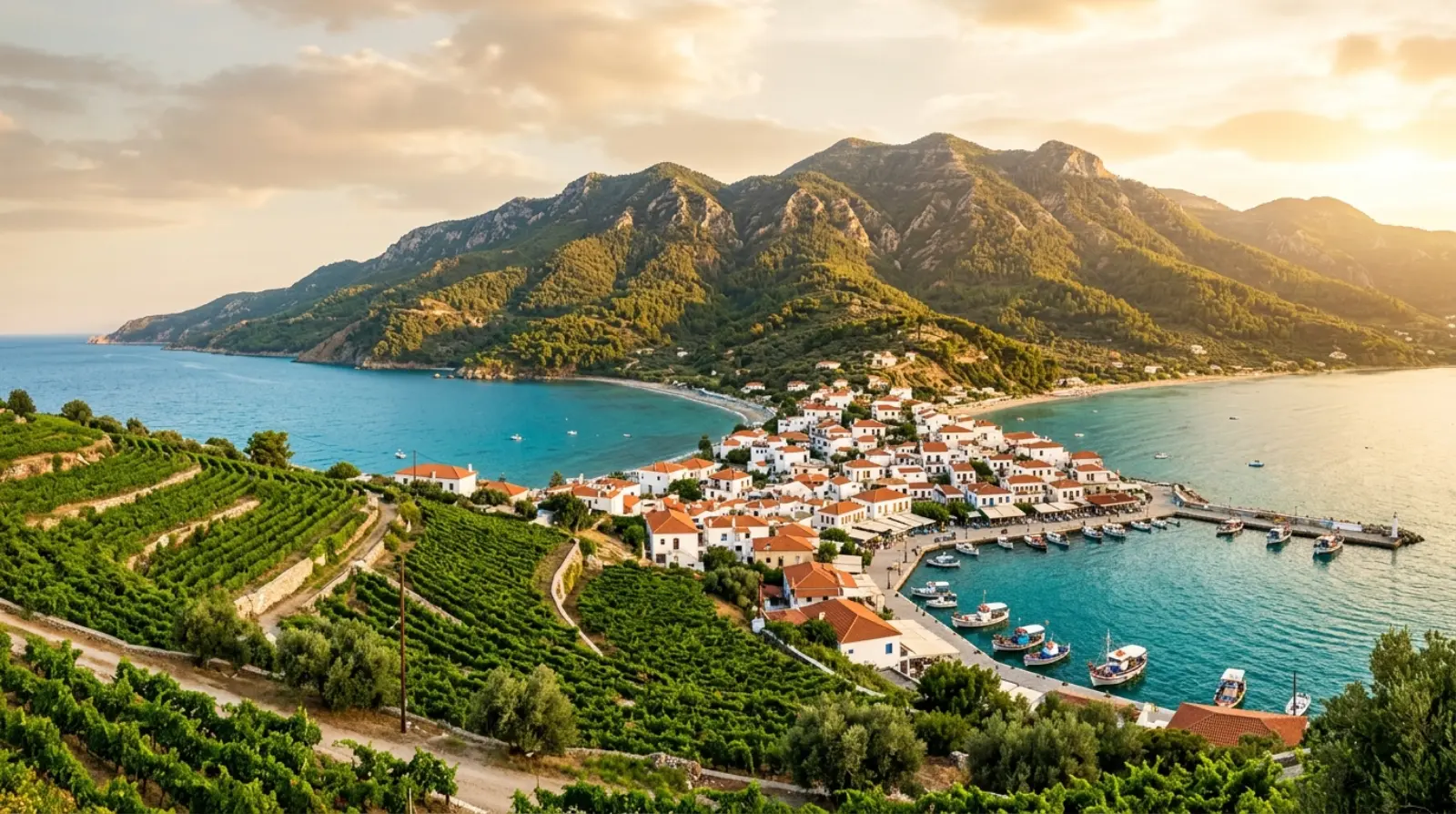
Samos at a Glance: Quick Facts for 2026
Samos is one of the largest and greenest islands in the Eastern Aegean, sitting closer to the Turkish coast than to Athens — and that geography shapes everything about a trip here. Around 480 km² in area, with roughly 30,000–35,000 residents spread across some 30 stone villages, it stretches from Mount Kerkis (1,434 m) in the west to the slopes of Ambelos in the centre. The UNESCO-listed Pythagoreion and Heraion of Samos, inscribed in 1992, anchor its ancient credentials, while viticulture — Muscat under PDO status — keeps the economy working year-round. Logistically, Samos Airport (SMI) handles the ~55-minute hop from Athens, and ferries link the island with Piraeus year-round and with Kusadasi in about 45–90 minutes. Season runs May–October. I've pulled the essentials into one guide — deeper detail lives in the cluster hubs on ferries, where to stay, things to do and car rental.
Is Samos Worth Visiting? My Honest Verdict
Short answer: yes — and with fewer compromises than most. I've visited Samos repeatedly since 2019, and it still delivers what package islands sold decades ago: a birthplace of Pythagoras, two UNESCO sites, PDO Muscat wine and low-key bases like Kokkari. The verdicts below split by traveller type. Compared with a typical small Cycladic island, the differences are stark — the table below sums up my view.
| Samos | Typical small Cycladic island | |
|---|---|---|
| Size | ~480 km² | much smaller |
| Landscape | pine forests, vineyards | largely arid |
| UNESCO sites | 2 (Pythagoreion & Heraion) | usually none |
| From Türkiye | ~45–90 min ferry | no direct crossing |
Compare hotels
This search box is provided by a booking partner and sets cookies.
Booking with a partner may earn this site a commission at no cost to you.
What Kind of Island Is Samos?
Samos surprises most first-time visitors — after the Cyclades, its pine-covered mountains look almost Alpine. A good year brings up to 80 cm of rain, enough to keep vineyards, olive groves and pine forests cloaking the slopes of Kerkis (1,434 m) and Ambelos, and roughly 30 villages with tiled roofs and painted shutters still living off farming — wine, olive oil, honey — alongside tourism. The summer Meltemi wind cools things down and occasionally chops up an otherwise calm beach day; I cover the patterns in my weather guide. Honesty requires the 2000 wildfire: a week-long blaze burned close to half the forest, yet the slopes have regenerated visibly on my visits since. That landscape dictates the rhythm of a trip — walking trails, mountain villages, green gorges — rather than a beach-only one. It's a contrast Greeks themselves holiday for.
Who Samos Suits (and Who It Doesn't)
After several trips around the island, I can say plainly: Samos rewards explorers and politely bores clubbers. It suits self-drivers above all — a hire car is practically a prerequisite for the remote coves and hill villages — plus hikers, with hundreds of kilometres of waymarked trails, and history lovers, who can pair the UNESCO sites with Ephesus just across the water. Families do well in Pythagorion: a harbourfront promenade, sandy shallow beaches and an archaeological museum holding a colossal kouros of Hera. The honest downside: if you won't drive, weigh it up first — buses cover the island patchily (see my guide), and bars in Pythagorion, Vathy and Kokkari are as lively as nightlife gets.
My verdicts by traveller type:
- Hiker: waymarked trails across Kerkis and Ambelos
- History buff: 2 UNESCO sites plus Ephesus nearby
- Family: Pythagorion's sandy shallows
- Beach-lounger: Tsamadou, Psili Ammos
- Nightlifer: look elsewhere
How Many Days Do You Need in Samos?
My short answer: give Samos at least five days, ideally a week. Realistically, two days of any trip disappear into transfers — the overnight ferry from Piraeus or the flight — leaving three for the island itself. A week lets me add an Ephesus day (ferry from Pythagorion, ~45–90 minutes each way, plus border formalities — details in my Ephesus day trip guide), a boat day to Samiopoula, and unhurried time for the mountain villages and Potami waterfalls. Ferry timetables shift by weekday and season, so verify current schedules on my Kusadasi route page and ferry hub. Three days only makes sense combined with another island; for most, seven is the sweet spot — the activity list sits at my things-to-do hub.
How I Get to Samos: Why the Ferry Wins
The ferry to Samos is the arrival method I recommend in this guide: Piraeus and Rafina connect with Vathy year-round, while Kusadasi sits barely 45–90 minutes across the strait. Flights to Samos from Athens take roughly 55 minutes into SMI. Here is how the main Samos ferry routes for 2026 compare:
| Route | Port | Duration | Season |
|---|---|---|---|
| Piraeus → Samos | Piraeus to Vathy | 8–10+ hours | Year-round |
| Kusadasi → Samos | Kusadasi to Vathy | ~45–90 minutes | Seasonal |
| Seferihisar → Samos | Seferihisar to Samos | ~90 minutes | Seasonal |
| Athens flight | ATH → SMI | ~55 minutes | Year-round |
Compare transfer prices
This search box is provided by a booking partner and sets cookies.
Booking with a partner may earn this site a commission at no cost to you.
Ferry to Samos from Athens (Piraeus & Rafina)
The classic way to reach Samos is the overnight ferry from Piraeus, and I rate it as part practicality, part old-school Aegean adventure. Piraeus is the year-round departure port for the ferry to Samos from Athens, with most sailings overnight and taking 8–10+ hours depending on the vessel and intermediate stops, often through Cyclades islands such as Mykonos or Syros. Rafina offers a seasonal alternative, though schedules differ from Piraeus and shift each year.
I always book a cabin rather than a deck seat — the price difference is modest for 8+ hours at sea, and arriving rested matters. One trap worth flagging: some sailings call first at Karlovasi, the island's second port, which lies 30+ km from Vathy. Check your arrival port when booking, because the Piraeus–Samos sailing time means little if you disembark on the wrong coast. For July and August, I book well ahead, and verify current schedules — they shift each year. Occasional summer day sailings exist, but treat them as a bonus rather than a plan.
Ferry from Türkiye: Kusadasi & Seferihisar Crossings
No other Greek island puts you this close to Turkey — from Kusadasi, the fast ferry reaches Vathy in roughly 45 to 90 minutes depending on the service. This Kusadasi–Samos ferry crossing is Samos's unique selling point for 2026, turning combined Greece–Türkiye trips into something genuinely practical: Pythagorion makes an easy base for an Ephesus day trip, and Ephesus is the main reason travellers combine the two countries.
I have done this crossing twice, and passport control is thorough — allow time on both sides, because this is a genuine international border and documents are checked in both ports. Check official sources for current visa requirements rather than relying on forum advice; I cover the paperwork in detail in my Turkey visa and border guide. Seferihisar, near Çeşme, provides a seasonal alternative crossing worth checking if Kusadasi sailings are full. For the Ephesus side of the equation, see my Ephesus day trip guide further down this page.
Flying to Samos
Flying is the fast option: Athens to Samos takes around 50 to 55 minutes with Aegean, Olympic Air or Sky Express. From Thessaloniki, flights to Samos run about 1 hour 25 minutes. Samos Airport (SMI) sits minutes from Pythagorion, which makes that village the most convenient first base for anyone landing on the Athens–Samos flight; the transfer to Vathy takes roughly 30–40 minutes along the island road. The airport itself is small, so expect a simple, quick arrival.
For UK travellers, direct seasonal charters appear some summers, but seasonal routes are subject to change — verify current 2026 routes before booking; otherwise the reliable pattern is a connection through Athens. I fly when time is tight and take the ferry when the journey matters: the plane wins on speed, the ferry on price and atmosphere, and your budget should decide.
Getting Around Samos: Why a Car Wins Here
Samos spreads across roughly 480 km² of mountains, beaches and around 30 villages, so getting around is the first logistical decision of any trip. The sights I rate highest — the Potami waterfalls among them — sit far from Pythagorion, and a car rental solves that spread better than anything else.
Renting a Car in Samos: Practicalities
Renting a car is, in my view, the single best practical decision you can make on Samos. Pick-up at Samos Airport (SMI) puts you about ten minutes from Pythagorion, and agencies also meet arrivals at the ports in Vathy and Karlovasi. Small manual hatchbacks are the standard hire here, and they suit the island: the asphalt is good, but mountain roads to Manolates or Vourliotes are narrow, steep and full of hairpin bends where a compact car is simply easier. Before booking, check the insurance excess and fuel policy — some companies run full-to-full, others less generous terms, and zero-excess cover is worth comparing in advance. A GB driving licence is valid in Greece, so no international permit is needed for UK visitors. One practical note: fuel stations thin out noticeably west of Karlovasi, so fill up before exploring the Kerkis coast. Verify current rates and policies with the rental company; my full notes on agencies and pricing are on the car rental page.
Buses, Taxis & Two-Wheelers
You can do Samos without a car — I've done it — but you'll be planning your days around the KTEL timetable rather than the other way round. KTEL Samos buses are cheap (a few euros) and dependable, but most departures run along the core Vathy–Karlovasi–Pythagorio corridor; mountain villages and the west coast see far fewer services, and Vathy is the hub everything starts from. Pythagorion makes the best car-free base because you can walk to tavernas, beaches and the Eupalinos tunnel area. Taxis often run fixed fares on popular routes rather than meters — agree the price before you set off. Scooters and quads rent cheaply and suit short hops, but I'd warn against taking them up the steep gravel climbs towards Manolates and Vourliotes; the mountain roads deserve four wheels. For a sensible no-car strategy, stay in Pythagorion or Vathy, use KTEL for the main corridor, and treat taxis as your fallback. Verify current timetables on the KTEL website or at the Vathy station, as schedules thin out outside summer.
Where to Stay in Samos: How I Choose My Base
Choosing where to stay in Samos shapes the whole trip, because the best towns — Pythagorion, Vathy, Kokkari and the Marathokambos coast — each deliver a different island. For 2026, accommodation books up earliest in August, so decide your base before you book ferries or a car. My short version: first-timers should pick Pythagorion, while the Samos west coast hotels suit returners with wheels. Each option is compared below.
Pythagorion: The Best All-Round Base
If you're torn, start in Pythagorion — it's the base I recommend to first-time visitors more than any other. The harbour is lined with tavernas, the stone lanes behind it hold most of the rooms, and the town's main beach sits roughly 15 minutes' walk away. The UNESCO-listed Pythagoreion and Heraion of Samos, inscribed in 1992, are effectively on your doorstep: the Eupalinos Tunnel is minutes from town and the Heraion about 10–15 minutes by car. Samos Airport (SMI) is roughly 10 minutes' drive, which matters for early flights. Boat trips to Samiopoula also depart from Pythagorion harbour — I cover the best of these in the things to do section. That mix of sights, beaches and logistics is why I call it the practical default; the alternatives below trade convenience for character.
Vathy vs Kokkari: City Port or Beach Village
Choosing between Vathy and Kokkari comes down to one honest question: do you want a working city or a wind-blown beach village? Vathy is the capital and main port, so it serves ferries from Piraeus and Rafina and suits overnight arrivals. The Archaeological Museum of Vathy displays archaic finds from the Heraion, including a celebrated statue of Hera. The trade-off: Vathy has few proper town beaches, so swimming means driving. Kokkari, the island's second-busiest resort, is a fishing harbour wrapped in tavernas, with Tsamadou and Lemonakia beaches a couple of minutes away by car. Its constant Meltemi exposure makes it the island's windsurfing centre — sailors love it, glassy-water swimmers may not. I split the difference by weighing logistics: Vathy wins for urban convenience and ferry connections, Kokkari for a beach-and-sport rhythm. Weigh both against Pythagorion in the table above before committing.
The Quiet West: Marathokambos & the Kerkis Coast
If your idea of a Greek island holiday involves silence, pebbles and tavernas where the owner knows every guest, the Marathokambos bay on Samos's southwest coast is your spot. When I want to show people the quiet side of Samos, I point them here: Ormos Agiou Isidorou sits on the water with a long pebble beach, while Mount Kerkis (1,434 m, the island's highest summit) dominates the whole bay. There's almost no package tourism, and dive spots lie off the Kerkis coast. The catch is logistics: buses run infrequently, so car rental in Samos is a practical necessity, and the drive from Vathy or Pythagorion takes about an hour — see getting around Samos. Off-season many tavernas close, so verify current openings. I'd only base myself here on a return visit; first-timers should still look to Pythagorion or Kokkari.
Things to Do in Samos: From Ancient Wonders to Waterfalls
Samos rewards travellers who plan around two anchors: the UNESCO-listed Pythagoreion and Heraion, with the Eupalinos Tunnel as its engineering star, and a coastline that swings from the windsurf beaches of Kokkari to boat days off Samiopoula. Add Samos wine tasting and you have my best of Samos island shortlist — the Samos activities for 2026 I actually recommend, detailed below.
Eupalinos Tunnel & the Heraion: Samos's UNESCO Duo
The Tunnel of Eupalinos is, quietly, one of the most remarkable engineering feats of the ancient world — and most visitors to Samos have never heard of it. Built in the 6th century BC as an aqueduct, it runs 1,036 metres through the mountain above Pythagorion, excavated from both ends simultaneously — a process that took roughly a decade and met with astonishing precision. Today you enter near Pythagorion itself, though interior sections close periodically, so verify current status before visiting.
A few kilometres away, the Heraion was the great sanctuary of Hera, once crowded with more than 100 marble columns; a single one still stands. Both sites were inscribed together on the UNESCO World Heritage List in 1992 as "Pythagoreion and Heraion of Samos". With a base in Pythagorion, you can comfortably see the pair in one day.
Beaches: Tsamadou, Psili Ammos & Potami Waterfalls
Samos's beaches split cleanly in two: the green, dramatic north coast — and the calm, swimmable south. The dividing factor is the meltemi, the summer northerly wind that exposes beaches like Tsamadou, Lemonakia and the bays at Kokkari to waves; in peak meltemi season Kokkari draws windsurfers and its flags stay up most weeks. Tsamadou, the island's flagship, has long had a free-spirit section at its right-hand end. If flat water matters to you, head south: Psili Ammos and Potokaki sit sheltered near the Turkish coast. Potami waterfalls, reached on foot from Potami beach by Karlovasi past old stone bridges, offer pools and wooden ladders to climb — though flow depends heavily on seasonal water levels, and access can vary, so check conditions. For a change of rhythm, boats run from Pythagorion to Samiopoula, a small sandy islet south of the island. My rule of thumb: north coast for scenery and atmosphere, south for swimming, and I match the beach to that day's forecast — the meltemi decides more Samos holidays than people expect, as I explain in my weather guide.
Mountain Villages & Hiking: Manolates, Vourliotes, Cave of Pythagoras
Half an hour above the coast, Samos turns into a different island: villages with painted shutters clinging to the slopes of Mount Ampelos. Manolates and Vourliotes — the latter via a steep road from the north coast — offer tiled roofs, cobbled lanes and tavernas under plane trees, a complete contrast to the beach resorts. By tradition, Pythagoras hid from his rivals in the Cave of Pythagoras on Mount Kerkis; the trail above is short but steep, so wear proper shoes. Marked hiking trails criss-cross the island between villages and peaks. My tip: these villages come alive at weekend lunchtimes — time your visit for a Sunday meal.
Samos Wine & Food: Muscat, Metaxa Roots, Tavernas
Wine is not a side note on Samos — the island's sweet Muscat has been exported for well over a century, and you can taste it at the source. I visited the EOSS cooperative in Vathy, which unites most of the island's growers and runs the Samos Wine Museum in an old stone warehouse; after the free tasting, I left with a bottle. The grape is Muscat Blanc à Petits Grains, grown on terraces climbing Ambelos. Pair a glass with grilled octopus at a Pythagorion taverna — my full Muscat wine-tasting guide lives in the things-to-do hub.
My Ephesus Day Trip from Samos: The Turkey Add-On
Few Greek islands let you wake up in one country and spend the afternoon in another. From Pythagorion, a day trip to Ephesus from Samos is genuinely feasible: the ferry crossing to Kusadasi takes roughly 45–90 minutes, border control follows, and then the Library of Celsus awaits.
Ephesus Practicalities: Timing, Tickets & Border Notes
The Ephesus day trip works — but only if the timetable maths adds up. Start early: cruise ships dock at Kusadasi through the morning, and their passengers flood the site by 10–11am. On my trip I reached the Library of Celsus at opening time and by midday barely recognised the path — the crowds were that dense. Allow 2–3 hours on site as a realistic estimate; that covers the Library, the theatre and the main marble street without rushing.
Border control is the second constraint. Passports are checked on arrival at Kusadasi, which eats 30–60 minutes each way. Independent travellers must match the Samos–Kusadasi ferry schedule against Ephesus's opening hours, or the day collapses; an organised tour handles both. Ticket prices and hours change seasonally — check the official site for current details. Worth it? Yes, with honest expectations.
Practical Samos: Money, Connectivity & When to Come
Once you have sorted the ferry to Samos and your base, three practical decisions shape the trip: how you pay, how you stay connected, and when exactly you come. Samos Airport (SMI) receives you, the Meltemi wind defines your beach days, and the winter ferry schedule can make or break an off-season plan.
Money, Payments & Staying Connected
Samos is card-friendly in the towns, but I would never tour this island without a few euros of cash. At a taverna near Potami waterfalls my card was simply not accepted — that is normal for small village establishments, kiosks, and boatmen. ATMs cluster in Vathy (Samos Town) and Karlovasi, where the main banks sit, and Kokkari has one on the waterfront; in remote mountain villages such as Manolates do not count on finding one at all.
Mobile signal is solid in the towns and along most of the coast, but thins out in the mountain valleys. I set up an eSIM with a Greek data plan before flying into SMI — see my eSIM guide — and it covered the towns fine, though I keep offline maps for the interior. As a UK reader, I also check my operator's roaming terms before every EU trip: since 2021, free EU roaming is no longer guaranteed by default.
Pre-trip digital checklist
- eSIM : activated before departure to SMI
- Offline maps : downloaded for the mountain interior
- Ferry e-tickets : saved for offline use
- EU roaming : checked with your UK operator
When to Visit Samos (and Two Moments to Know)
If I had to pick two weeks, I'd take mid-June or the first half of September — green island, warm sea, and none of the August crush. The sweet spots are May–June, when Samos is at its greenest with fewer crowds, and September–October, when the sea holds its summer warmth. In July and August, temperatures regularly exceed 30°C, prices peak, and the island fills up.
The second thing to know is the Meltemi wind, the seasonal northerly that blows mainly in July and August. I have watched it cool the air pleasantly while chopping up the swell on the north coast — Kokkari, windy at the best of times, and Tsamadou both take it — while beaches on the south side stay calm.
Two practical caveats: in winter, the ferry to Samos from Piraeus runs on a reduced schedule, and flights into SMI become less frequent outside the season, so verify current timetables before booking a shoulder-month trip. The full month-by-month picture is in my weather guide. And if August is your only option? Everything still runs — just book accommodation and ferries well ahead.
Safety, Entry Rules & Insurance
Samos is one of the more relaxed islands I've been on — petty crime is low, the villages feel safe after dark, and the main safety notes are ordinary ones: sun, cliffs, and the sea. Treat the Meltemi flag warnings on north-coast beaches seriously.
The formalities matter more here than on most Greek islands because Samos sits beside Türkiye. UK passport holders enter Greece under standard Schengen rules, and any crossing to Kusadasi or Seferihisar — including the short ferry from Pythagorion — triggers full passport control, so carry a valid passport and the correct entry documents even for a 45-minute hop. Requirements change: check the FCDO travel advice and official Greek and Turkish sources before you book, and see my Turkey border guide for the detail. For British travellers, the GHIC covers emergency care in Greece as a minimum, but it is no substitute for proper travel insurance.
How I Plan a Samos Trip: Start Here
When I plan a Samos trip, I make four decisions in this order: how to get there, where to sleep, whether to rent a car, and what to bolt on. Ferry route first, because the Kusadasi crossing changes everything — it opens the door to an Ephesus day trip — so start at the ferry hub and, if Türkiye appeals, the Kusadasi route page. Then pick a base on the accommodation page; I usually weigh Pythagorion against Kokkari depending on whether a hire car will be doing the driving — the honest comparison is in my getting-around guide. Add-ons come last: beaches and villages on the things-to-do hub, Ephesus logistics in the day trip guide, connectivity in the eSIM guide, and timing via the weather guide. One thing to know about this site: I take no bookings — I am a single independent author telling you what to verify.
FAQ
I answer the questions readers ask me most often before booking a Samos trip — ferries, trip length, car hire and the Ephesus add-on.
Is Samos worth visiting compared with other Greek islands?
In my view, yes, if you want a big (~480 km²), green, mountainous island with real local life alongside beaches and major sights — the UNESCO-listed Pythagoreion, Heraion and Eupalinos Tunnel. It suits you less if you want nightlife or a car-free package strip. It's also one of the few islands with an easy Türkiye add-on.
How do I get to Samos — ferry or plane?
Ferries from Piraeus run year-round, roughly 8–10+ hours, often overnight, arriving at Vathy or Karlovasi. Flights from Athens take around 50–55 minutes to SMI, near Pythagorion. The wildcard: crossings from Kusadasi and Seferihisar in Türkiye take only about 45–90 minutes. Verify current timetables and fares with operators before booking.
How many days do you need in Samos?
I recommend 5–7 days minimum. A week covers the Eupalinos Tunnel and Heraion, beaches on both coasts, a mountain-village day (Manolates or Vourliotes), a Samiopoula boat trip and a day trip to Ephesus without rushing. The island's size and mountain roads punish over-packed itineraries.
Do you need a car in Samos?
Practically, yes, if you want to see the island: sights and beaches are spread along mountain roads, and buses serve mainly the Vathy–Karlovasi–Pythagorion corridors. If you stay put in Pythagorion or Vathy, you can manage car-free. Check the insurance excess and fuel policy; verify current rental terms.
Can you do a day trip to Ephesus from Samos?
Yes — it's Samos's signature add-on. Take the morning ferry to Kusadasi (roughly 45–90 minutes), transfer about an hour to Ephesus, visit the Library of Celsus and return by the afternoon or evening sailing. Organised tours simplify border timing; independent travellers must match ferry schedules to site opening hours. Bring your passport and check current entry rules.